
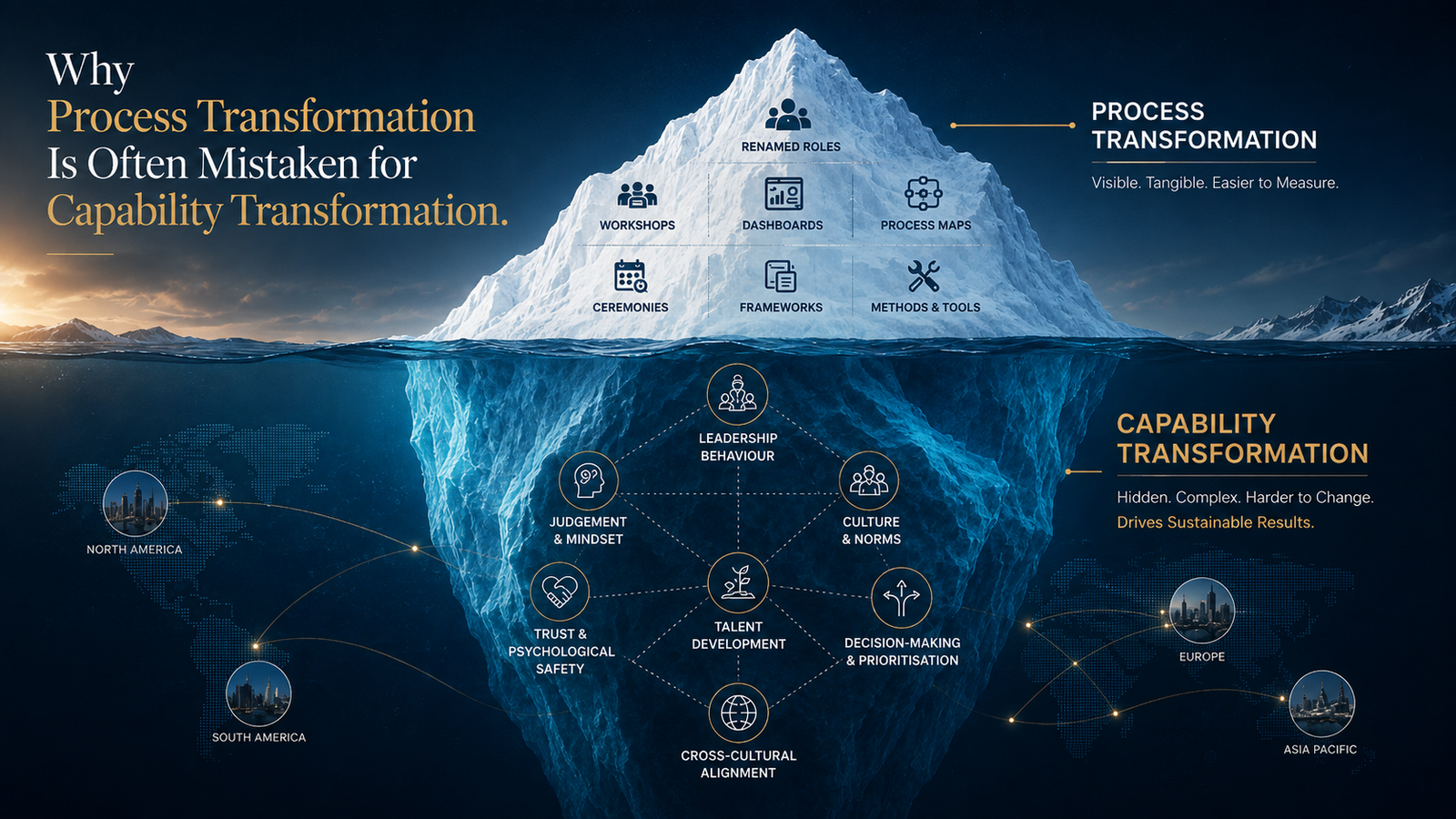
Most organisations are disciplined when it comes to visible cost.
They review budgets, challenge supplier spend, compare day rates, freeze hiring when markets tighten, and ask reasonable questions about return on investment. None of this is unusual. Cost discipline matters.
Yet some of the largest costs inside an organisation do not arrive as a clear invoice.
They accumulate through weak capability.
This is where the idea of capability debt becomes useful.
Capability debt is the cost created when organisations underinvest in the expertise required to run, improve, and transform the business properly. It builds when critical roles are filled cheaply, specialist disciplines are treated as interchangeable, training is seen as optional, and complex change is handed to people without the depth to lead it well.
For a period of time, this can appear efficient.
Later, it often becomes expensive.
What capability am I referring to?
Capability is a broad term, so it helps to be specific.
I am referring to the practical organisational capabilities that determine whether change efforts succeed or fail. Examples include:
- Agile capability: experienced delivery leadership, flow-based planning, prioritisation discipline, coaching leaders and teams, healthy delivery governance
- AI capability: use-case selection, operating model readiness, responsible adoption, workflow redesign, data literacy, business ownership of outcomes
- OKR capability: setting meaningful objectives, defining measurable outcomes, aligning teams, running quarterly review rhythms, avoiding vanity metrics
- Transformation capability: change leadership, stakeholder alignment, programme execution, benefits realisation, decision-making discipline
- Product capability: customer insight, roadmap judgement, value prioritisation, cross-functional execution
These are not fashionable labels. They are operating capabilities.
When they are weak, organisations slow down, overspend, and struggle to convert investment into results.
Where many organisations go wrong
A common pattern is to focus heavily on rates while paying less attention to capability.
Examples include:
- hiring the cheapest consultant rather than the most capable one
- filling specialist roles with generalists who lack depth
- expecting junior hires to solve senior problems
- launching Agile without experienced coaching
- buying AI tools without building internal readiness
- adopting OKRs without anyone who understands how to make them work
- rotating short-term resources with little continuity or ownership
On paper, these decisions can look efficient.
In practice, they often create fragile systems, confused teams, and poor-quality delivery.
Poor-quality work compounds
One of the most expensive consequences of weak capability is that poor work rarely stays contained.
It spreads.
An inexperienced transformation lead may create unclear governance.
Weak Agile implementation may create ceremonies without accountability.
Poorly designed OKRs may drive activity without outcomes.
Low-quality AI programmes may produce pilots with no operational value.
Underqualified delivery hires may create process clutter, delays, and rework.
By the time stronger people are brought in, they are no longer starting with a clean slate.
They inherit:
- broken trust
- delivery fatigue
- poor data quality
- confusing processes
- weak habits
- stakeholder scepticism
- technical or operational backlog
- teams who have lost confidence in “the next initiative”
This means good hires often spend their first months repairing avoidable damage rather than creating progress.
That repair cost is rarely attributed to the original low-quality decision.
The hidden financial loss
This is why capability debt becomes a financial issue.
The cost is not simply the salary or contractor rate. It is the wider economic impact of weak capability.
Examples include:
- delayed revenue initiatives
- missed transformation milestones
- duplicated work across teams
- expensive remediation programmes
- prolonged consultant dependency
- low return from technology investments
- higher attrition of strong staff
- slower decision-making
- avoidable management overhead
An organisation may save £300 per day on a role, while losing multiples of that amount through delay, confusion, and underperformance elsewhere.
Visible savings can mask invisible waste.
Why this matters now
The current environment places more pressure on productivity, margin, and measurable outcomes.
Leaders are being asked to justify technology spend, improve execution speed, and deliver more with constrained budgets.
In that environment, capability becomes more important, not less.
When organisations try to save their way out of complexity while underinvesting in expertise, they often create larger costs later.
What stronger organisations understand
Better-performing organisations usually recognise that some capabilities are leverage points.
They are willing to invest properly in areas such as:
- strong Agile and delivery leadership
- credible transformation practitioners
- experienced product leadership
- AI readiness and adoption capability
- high-quality OKR coaching and operating cadence
- internal capability transfer from external experts
- management development during periods of change
They understand that one strong hire can remove friction across many teams, while one weak appointment can multiply friction across the business.
A better executive question
Many organisations ask:
What is the cheapest rate we can secure?
A stronger question may be:
What level of capability will create the highest return once delivery quality, speed, and sustainability are considered?
That question changes the economics of the conversation.
Final reflection
Many organisations still view capability through the lens of training budgets, recruitment challenges, or professional development programmes. Those things matter, but they only tell part of the story.
Capability ultimately determines how effectively an organisation converts investment into outcomes. It influences the quality of decisions that are made, the speed at which opportunities are pursued, the effectiveness of technology adoption, and the organisation’s ability to navigate periods of change without creating unnecessary disruption.
This becomes particularly relevant in areas such as Agile transformation, AI adoption, product operating models, and OKRs. These disciplines often appear deceptively simple from a distance. Frameworks can be purchased, tools can be implemented, and consultants can be engaged. Building the capability required to apply them well is a different challenge altogether.
When capability is underestimated, organisations often find themselves addressing the same underlying problems repeatedly. Delivery slows, confidence declines, transformation programmes require additional intervention, and expensive technology investments struggle to realise their intended value. By that stage, the conversation is no longer about capability development. It is about productivity, cost, risk, and performance.
Perhaps the more interesting question for leaders is not whether capability matters, but whether its absence is already creating costs that remain largely invisible.
Where are decisions being delayed because the necessary expertise does not exist?
Which transformation initiatives are taking longer than expected because critical capabilities were never fully established?
How much organisational energy is currently being spent compensating for weaknesses that have gradually become accepted as normal?
And if capability were treated as a strategic asset rather than an operational expense, what might become possible?
The organisations that navigate the next decade successfully may not be those that invest the most in technology, frameworks, or external support. They may be the organisations that recognise capability as the foundation upon which all three ultimately depend.
Leave a Reply