
In my previous article, I wrote about capability debt and why underdeveloped capability eventually shows up in productivity, performance, and financial outcomes. This article continues that argument from a different angle. If capability debt is the cost of not building the right skills, behaviours, and judgement over time, then process transformation is one of the places where that debt often hides in plain sight.
Many organisations begin transformation with serious intent. A new framework is introduced because the current way of working no longer feels effective. Existing governance forums are reshaped so that planning, review, and decision-making can happen with a better rhythm. New roles appear across the organisation, often with titles that signal a move towards agility, product thinking, ownership, or outcome focus. Coaches and consultants are brought in to support the transition, while leaders communicate the need for a different way of working.
In the early stages, this can create the impression that the organisation is changing meaningfully. The language of work begins to shift, familiar meetings are replaced or renamed, and the new operating model starts appearing in conversations, dashboards, and leadership updates. There is visible movement, and for a while that movement can feel like progress.
Then, several months or years later, a familiar question begins to surface.
Why does the organisation still feel slow?
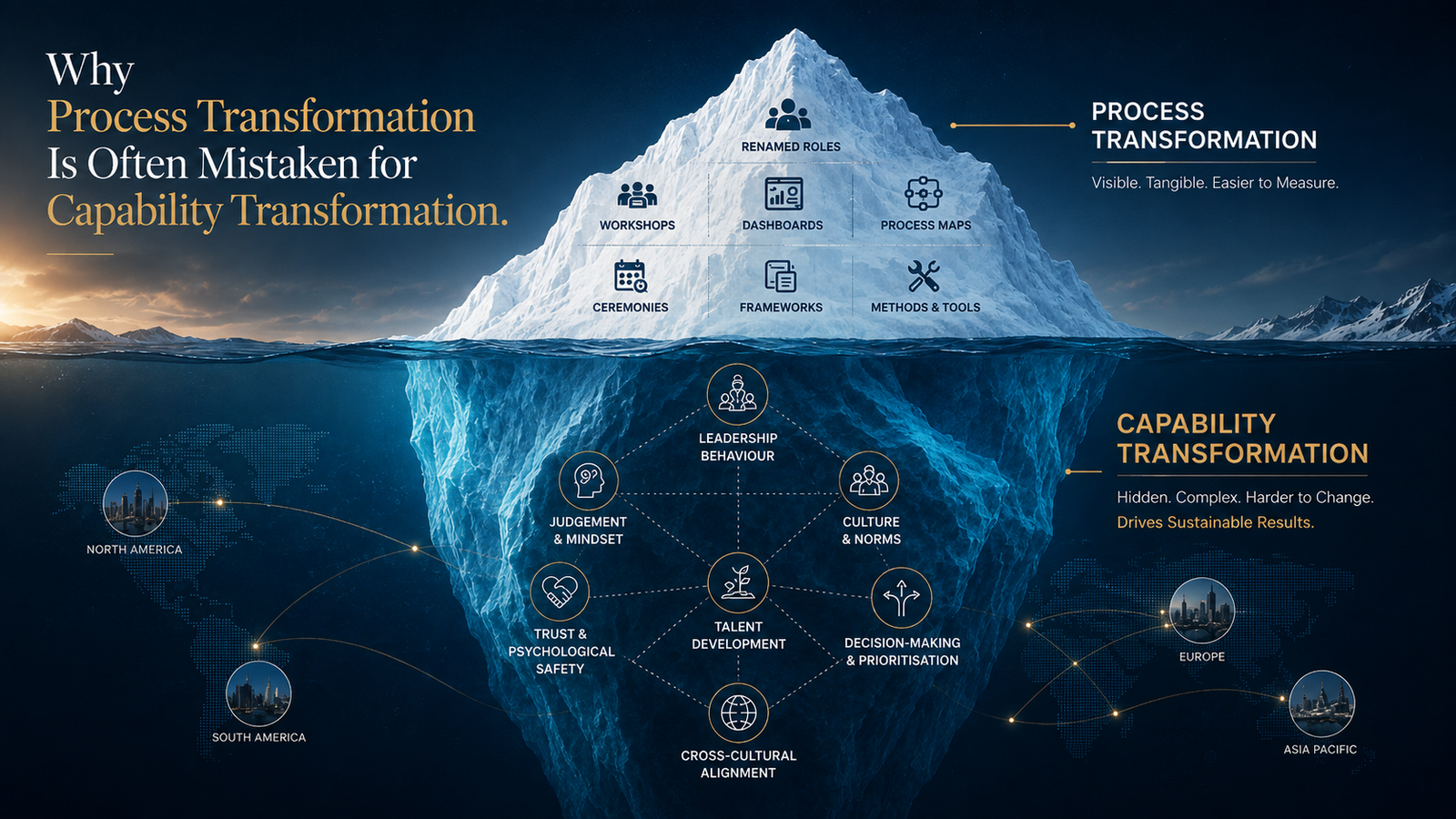
That question often reveals the difference between process transformation and capability transformation. Process transformation is usually about the visible mechanics of work: the meetings people attend, the roles they use, the way work is planned, the way progress is reviewed, and the way decisions are tracked. Capability transformation goes deeper. It is about whether people have the judgement, confidence, leadership behaviours, and organisational understanding to make those new ways of working actually mean something.
This distinction matters because an organisation can look transformed from the outside while many of the old behaviours continue underneath. The terminology may have changed, but the thinking behind the work may still belong to the previous world.
The delegation trap
One pattern I have seen repeatedly in large organisations is the belief that transformation can be delegated.
Senior leaders may attend an executive workshop, approve the transformation roadmap, sponsor a new framework, and then hand over the practical work to Agile Coaches, transformation teams, delivery leads, middle managers, or external consultants. There is often good intent behind this. Leaders are busy, organisations are complex, and transformation programmes need people who can design, coordinate, and support the change.
The difficulty begins when delegation creates distance.
Leaders may believe they have played their part because they attended the training, signed off the model, and asked others to implement it. In reality, transformation asks much more of leadership than sponsorship from a safe distance. It asks leaders to look at how their own decisions, expectations, governance habits, communication patterns, and interventions shape the system that everyone else is trying to change.
This is where many transformations become constrained.
A team may be trained in Agile ways of working, but if leadership still expects fixed scope, fixed dates, fixed cost, and fixed certainty at the beginning of complex work, the team quickly learns which system truly matters. A Product Owner may be given a new title, but if meaningful prioritisation still happens elsewhere without the right product context, the role remains limited. A delivery team may be asked to take ownership, but if every difficult decision is pulled back into old approval channels, ownership becomes more theoretical than real.
This is how process transformation becomes separated from capability transformation. The organisation changes the instructions given to teams, while the wider system continues to send many of the same old signals.
Why team-level change often reaches a ceiling
Agile transformations often begin with teams because teams are visible, practical, and relatively easier to train. A team can learn Scrum or Kanban. It can improve its planning, visualise its work, refine its backlog, run retrospectives, and create shorter feedback loops. These changes can produce genuine improvements, and it would be unfair to dismiss them.
The problem is not that team-level improvement has no value. The problem is that organisations often expect team-level improvement to create organisational transformation by itself.
A team may become more transparent, while the portfolio remains fragmented. A team may improve its delivery discipline, while funding still follows annual planning cycles. A team may learn to work iteratively, while governance continues to ask for certainty too early. A team may remove waste from its own process, while the organisation continues to create dependencies that slow work across the wider system.
After a point, the team encounters the limits of the environment around it.
This is one reason Agile transformations can remain stuck at team level. Teams improve within their area of influence, but the surrounding system often remains much the same. Work still enters the system in the old way. Investment decisions are still made in the old way. Leaders still intervene in the old way. Success is still measured in the old way.
When this happens, organisations can misread the problem. They may decide that Agile has not delivered enough value. They may change the framework, restructure the teams, replace the coaches, or launch another wave of training. Some of these actions may have merit, but they rarely address the deeper issue if the organisation is still treating transformation as a process rollout rather than a capability-building exercise.
Role transformation is not the same as talent transformation
Another common pattern is the assumption that assigning new roles creates new capability.
This is understandable because role changes are visible. They appear in organisation charts, job descriptions, governance documents, career paths, and delivery models. They create the sense that the organisation has moved from one model to another.
The harder question is whether people have developed the capability required to operate differently.
A person can be renamed as a Product Owner and still behave mainly as a requirements coordinator. A manager can be described as an Agile leader while continuing to lead through control, escalation, and task supervision. A team can adopt the language of outcomes while still being measured for activity. A transformation office can speak about empowerment while creating additional reporting layers that pull decision-making back to the centre.
In most cases, this is not a simple people problem. People often continue to behave in familiar ways because those behaviours have been reinforced over many years. Organisations train people through incentives, approvals, reporting expectations, leadership reactions, promotion criteria, and the way difficult conversations are handled. When the label changes but the underlying capability is not developed, old behaviours naturally reappear inside new structures.
This is why talent transformation matters.
If ways of working are expected to change, the organisation has to invest in the human capability required to make that change real. Leaders need to learn how to create clarity without over-controlling. Product roles need to build judgement around value, prioritisation, customer insight, and trade-offs. Delivery roles need to understand flow and dependency management beyond the mechanics of ceremonies. Teams need the confidence and maturity to challenge constructively, learn openly, and adapt with discipline. Stakeholders also need to understand their part in the new system, because transformation does not happen only inside delivery teams.
Without this deeper talent transformation, organisations often end up performing new processes through old habits.
This can be difficult to see from a distance because the transformation still looks active. The calendar is full, ceremonies are taking place, boards are being updated, and people are using the language of the new model. Yet the mindset towards work, decision-making, accountability, and collaboration may remain very close to the old world.
The cross-cultural layer many transformations underestimate
The challenge becomes even more complex in multinational organisations.
Large organisations often try to create a common way of working across geographies, business units, delivery centres, vendors, and partner ecosystems. This is especially visible when a significant part of the delivery capacity sits across global capability centres and offshore locations, including large teams in India and other major technology hubs.
The intention is usually sensible. A common framework gives the organisation shared language, shared expectations, and a reference point for coordination. It helps leaders compare progress, align delivery, and create a common operating rhythm across a large and distributed environment.
The difficulty is that a common framework does not automatically create a common interpretation of work.
People bring different assumptions into the same model. Those assumptions are shaped by national culture, organisational culture, professional background, education, leadership experience, and the environments in which people have built their careers. They influence how people respond to ambiguity, how openly they challenge decisions, how they interpret accountability, how they escalate risk, how they engage with hierarchy, how they build trust, and how they balance technical execution with stakeholder influence.
This is where many transformations lose depth without realising it.
Some delivery environments are exceptionally strong technically and can mobilise large numbers of people with impressive speed and discipline. At the same time, the people side of transformation may require more deliberate development, especially when the work depends on stakeholder influence, emotional intelligence, leadership maturity, negotiation, and the confidence to challenge constructively. Other environments may place greater emphasis on relationship-building and stakeholder navigation, but may struggle with consistent execution at scale.
The point is not that one culture is better than another. The point is that different working cultures bring different strengths, blind spots, and expectations into the same transformation.
When those differences are not recognised, organisations can mistake surface alignment for genuine alignment. Everyone may attend the same training, use the same terminology, and follow the same ceremonies, while the behaviours underneath the process remain quite different. In one environment, a retrospective may become a genuine conversation about improvement. In another, it may become a polite ritual where the most important issues remain unspoken. In one leadership culture, escalation may be treated as transparency. In another, it may be seen as failure. In one environment, empowerment may be understood as decision rights. In another, it may be experienced as additional responsibility without enough authority.
These differences matter because transformation depends on behaviour, not vocabulary alone.
A leader with cross-cultural experience can often sense these patterns earlier. They understand that the same words do not always carry the same meaning in different environments. They know that alignment has to be built rather than assumed. They notice when people are complying with a process without internalising the intent. They can see when confidence, challenge, ownership, and decision-making are being shaped by cultural expectations that do not appear in any transformation plan.
That kind of organisational judgement is rarely captured in maturity assessments, but it is often critical to whether transformation succeeds at scale.
When scale weakens the original intent
Large-scale transformation introduces another challenge.
The original intent of the transformation is usually strongest at the centre, where the strategy is designed. Senior sponsors, transformation leads, consultants, and enterprise coaches may understand what the organisation is trying to achieve. They may understand the principles behind the change, the trade-offs involved, the operating model choices, and the behaviours that need to shift.
As the transformation travels across regions, suppliers, delivery centres, and layers of management, the quality of interpretation can weaken.
Training can become more standardised but less contextual. The language can spread quickly while the meaning becomes thinner. Local leaders may implement the visible practices while missing the deeper intent. Offshore teams may receive process instructions without enough exposure to the business context, stakeholder dynamics, customer outcomes, or leadership expectations that shaped the original design.
At scale, transformation does not fail only because people resist change. It can also weaken because the meaning of the change is not carried with enough depth through the organisation.
This matters when large numbers of teams are involved. If hundreds or thousands of people are expected to adopt a new way of working, the organisation needs more than a training rollout. It needs a capability-building system. It needs leaders at multiple levels who can interpret the change, contextualise it, coach people through it, correct misunderstandings, and reinforce the intent behind the process. It needs people who understand both the framework and the human system into which the framework is being introduced.
Without that, the transformation may spread widely while becoming shallow in practice.
Why frameworks are often blamed for systemic issues
When transformations stall, frameworks often become the easiest target.
Agile is blamed. SAFe is blamed. Product operating models are blamed. OKRs are blamed. Sometimes the criticism is fair because frameworks can be implemented poorly, over-engineered, or turned into compliance systems.
Yet in many organisations, the framework is not the root problem. The framework is exposing a capability gap that already existed.
A framework may reveal weak prioritisation, fragmented governance, unclear accountability, overloaded teams, rigid funding, slow decision-making, or poor leadership alignment. It may also reveal that stakeholders do not yet have the capability to work in an outcome-oriented way.
The framework can make these issues visible, but it cannot resolve them by itself.
This distinction is important because organisations sometimes respond to transformation fatigue by replacing one framework with another. They move from one model to the next, hoping that a different structure will produce better results. There may be occasions where a framework change is necessary, but if the underlying capability remains unchanged, the same patterns often reappear under new terminology.
The deeper question is rarely which framework the organisation should use. The more useful question is what capability the organisation needs to build in order to make any framework work well.
Transformation as capability-building
If organisations want transformation to reach beyond process, they need to treat capability-building as the real work.
This means leaders cannot remain outside the transformation and simply sponsor it from above. They have to participate in it by changing how they make decisions, how they set priorities, how they respond to uncertainty, how they create conditions for teams, and how they model the behaviours expected from others.
It also means transformation cannot be reduced to training attendance. Training is useful, but it is only the beginning. Capability develops through application, coaching, reflection, feedback, and repeated practice in real organisational conditions. People need help translating new concepts into the reality of their work, their stakeholders, their constraints, and their cultural context.
For global organisations, this becomes even more important. A transformation designed in one location cannot simply be pushed across the organisation as a standard operating procedure. It needs interpretation. It needs cultural intelligence. It needs local leadership maturity. It needs enough consistency to hold the enterprise together and enough contextual understanding to make the change meaningful in different environments.
This is where experienced transformation leadership matters.
The work is not simply to introduce Agile, OKRs, AI adoption, or a product operating model. The work is to help the organisation develop the capability to operate differently after the consultants have left, after the initial training has ended, and after the excitement of the programme has faded.
Final reflection
Many organisations genuinely want to transform, but they often underestimate what transformation asks of them.
It is much easier to change a process than to build the capability that gives the process meaning. It is easier to rename roles than to develop new judgement. It is easier to introduce ceremonies than to build trust. It is easier to attend executive training than to examine the leadership behaviours that shape the system. It is easier to announce a common framework than to work through the cultural differences that influence how that framework is understood across regions.
This is why some transformations appear to move forward while the organisation continues to experience familiar problems. The visible layer has changed, but the deeper layer has not matured at the same pace.
Perhaps the question leaders need to ask is not only whether their organisation has adopted a new way of working, but whether people have developed the capability to make that new way of working meaningful.
Have leaders changed how they lead, or have they delegated transformation to others? When roles change, has talent genuinely transformed, or has the organisation only changed the names people use? When teams adopt new routines, are they also developing new thinking? When global delivery centres receive the process, do they also understand the purpose? And when cultural differences influence how work is interpreted, are those differences being treated as part of the transformation challenge or as background noise?
These questions matter because transformation does not become real through process adoption alone. It becomes real when capability, leadership, culture, and ways of working begin to move together.
Until then, many organisations may continue to believe they have transformed, when what they have really done is change the language of work without changing the work itself.
Leave a Reply