
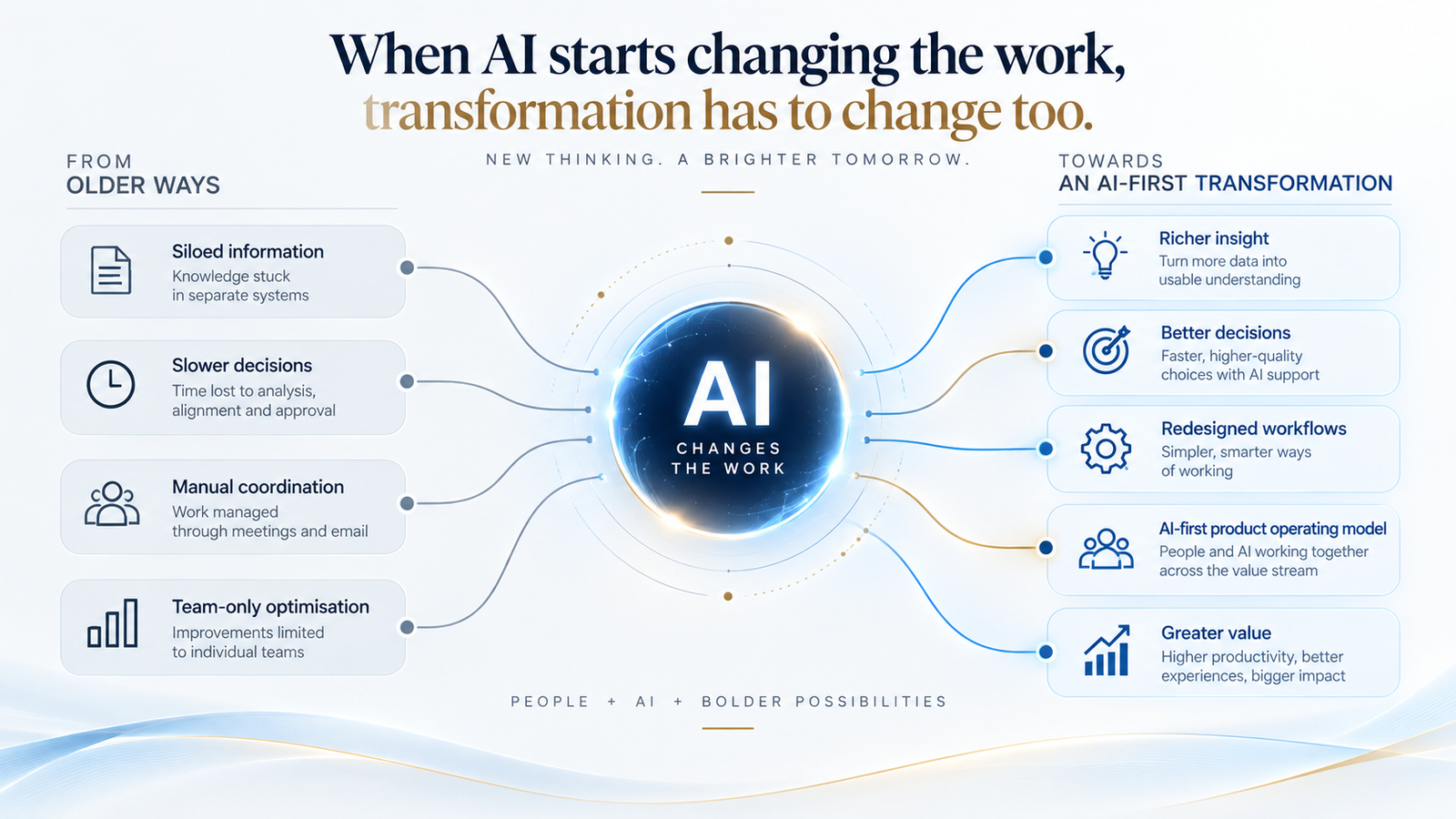
In my previous articles, I explored capability debt and the way organisations can mistake process change for real capability change. This article continues the same line of thinking, but from the perspective of AI and the way it is beginning to change work itself.
For many years, transformation has largely been shaped around improving teams, delivery rhythms, governance, product ownership, and prioritisation. Agile has played a significant role in that journey, as have product operating models, OKRs, Lean practices, and delivery frameworks. Each of these ideas has helped organisations move away from older ways of working that were often too slow, too controlled, or too disconnected from customer and business outcomes.
I do not think those ideas have lost their value, but they now sit in a different environment.
AI is beginning to influence the everyday work of thinking, analysing, learning, communicating, and preparing decisions. It is not simply helping people complete tasks faster. It is starting to change how knowledge work happens, how information moves through organisations, and how people make sense of complex situations.
That creates a different transformation challenge.
Until recently, many transformation programmes treated the team as the main unit of change. The belief was that if teams became more Agile, more cross-functional, more transparent, and more customer-focused, the organisation would gradually become more responsive. There is truth in that thinking, but there is also a limit to it.
A team can improve how it works while the workflow around it remains slow. A Product Owner can improve the quality of a backlog while the organisation still struggles to decide which outcomes matter most. A delivery team can use AI to summarise meetings or draft user stories while the wider operating model continues to move work through the same old decision points.
At that stage, AI may be improving tasks without improving the way the organisation works.
The risk of treating AI as an add-on
Many organisations are currently treating AI as a productivity layer that can be added to existing ways of working. Developers may be given coding assistants, analysts may use AI to support research, and product managers may use it to prepare discovery notes or backlog items. Delivery leads may also use AI to summarise discussions and prepare updates.
Those improvements can be useful, but they do not become transformation by themselves.
The larger question is whether the organisation is prepared to rethink the work itself. If AI can help people understand information faster, prepare decisions with better context, and identify patterns earlier, then the opportunity is no longer limited to helping existing teams move a little faster. It becomes an opportunity to examine how work travels through the organisation and ask whether some of those paths still make sense.
This means looking more closely at the places where decisions are delayed because information is scattered across too many systems and teams. It means noticing where people spend too much time chasing updates, reconciling different versions of the truth, or preparing status reports for forums that are still trying to understand what is really happening. It also means asking whether some governance structures exist because leaders do not have timely insight, and whether manual coordination has become a substitute for a better operating model.
Product operating models also need to be reconsidered
This conversation is not limited to Agile transformation. It is just as relevant to product operating model transformations.
Many organisations are implementing product operating models through domains, product roles, roadmaps, quarterly planning cycles, portfolio forums, and funding structures. These are important building blocks, but many of these models are still being designed as though AI sits outside the operating model rather than inside it.
A product operating model designed before AI became part of everyday work may still ask sensible questions about value, ownership, alignment, and outcomes. What it may not fully address is how product decisions could be prepared differently when AI is built into the way the organisation works.
Take a financial services organisation as an example. Product decisions rarely come from one clean source of information. A bank may be looking at a digital onboarding journey where customers are dropping out before completion. The product team may hear one version of the problem from customer complaints, another from operational teams, and another from technology teams looking at defects or platform constraints. Compliance or risk colleagues may also see concerns that do not appear in the product backlog until much later.
In a traditional product operating model, someone has to pull those signals together manually. Product managers gather inputs, analysts prepare packs, delivery leads explain dependencies, and leadership forums try to make decisions from information that has been assembled from many places. The quality of the decision often depends on who was in the room, which data was available at the time, and whether an experienced person was able to spot the pattern early enough.
In an AI-first product operating model, decision preparation can become more intelligent. AI can help surface patterns across customer feedback, operational issues, service failures, and delivery risks before they become visible through escalation alone. Instead of relying mainly on the loudest stakeholder or the most urgent meeting, product leaders can come into prioritisation discussions with a clearer view of where customer pain, operational cost, risk, and business value are starting to intersect.
A similar pattern can be seen in payments. A payments organisation may be dealing with failed transactions, settlement delays, merchant queries, and reconciliation issues. These signals may sit across different systems and teams, which means the connection between them often depends on experienced people recognising the pattern manually. With AI built into the operating model, those connections could be surfaced earlier, helping leaders understand whether they are dealing with a local defect, a process weakness, a platform constraint, or a product investment decision.
This changes the nature of product leadership. The Product Manager is no longer only gathering evidence and maintaining a roadmap. The role becomes more focused on interpreting insight, exercising judgement, challenging assumptions, and helping the organisation make better choices about where value is likely to be created.
That is why AI should not be treated only as something that supports a product operating model. It should influence how the operating model itself is designed.
Why Agile-led, AI-supported may not go far enough
The same issue appears in Agile transformation. An Agile-led, AI-supported approach may help teams improve productivity, but it may not go far enough if the organisation simply adds AI tools into existing structures.
If the funding model remains unchanged, governance continues to ask the same questions, leadership behaviours remain the same, and decision-making still moves through old channels, AI may only help people move faster through a system that needs to be redesigned.
This is where organisations need to be careful. AI can strengthen good ways of working, but it can also make existing weaknesses harder to manage. It can help people produce more content without improving the quality of thinking behind that content. It can create more analysis without helping leaders make clearer decisions. It can make old processes move faster while leaving the underlying question of value unanswered.
Capability becomes more important, not less, when AI starts to shape how work is done.
Leaders need to understand where human judgement remains essential and where AI can genuinely improve the quality of work. Product and delivery teams need to use AI without losing accountability for outcomes. Governance forums need to move beyond static reporting and learn how to engage with faster, richer insight. Organisations also need enough AI literacy to challenge outputs rather than accepting them because they appear confident or well written.
The real opportunity is not to place AI on top of every existing process. It is to ask which parts of work should now be redesigned because knowledge, analysis, and decision support are available in a different way.
The transformation question is changing
The next wave of transformation may not begin with the question, “How do we make teams more Agile?” It may begin with a more fundamental question: “How does work need to change now that AI can take part in research, analysis, coordination, and decision support?”
Agile still has a place in that conversation. The principles behind Agile may become even more valuable because organisations will need experimentation, feedback, learning, and adaptation as AI changes the pace of work. The difference is that Agile may increasingly become one of the disciplines that supports AI-led work redesign, rather than the primary transformation frame into which AI is inserted afterwards.
This distinction matters because organisations can easily repeat the same mistake they made with earlier transformations. They can buy tools, rename roles, run training sessions, create adoption dashboards, and believe that meaningful change is happening. The deeper test is whether the organisation has changed how work is understood, how decisions are made, how capability is built, and how value is created.
AI gives organisations a chance to rethink work more seriously than many previous technology waves allowed. The challenge is whether they will use that opportunity well.
Will they use AI mainly to speed up old processes, or will they redesign the processes that no longer make sense?
Will they give individuals better tools, or will they rethink how teams, leaders, governance forums, and operating models work together?
Will they treat AI as another productivity layer, or will they recognise it as a strategic transformation lever?
These questions matter because AI is not only changing the tools available to organisations. It is changing some of the assumptions behind how work gets done.
And when the work itself begins to change, transformation cannot remain the same.
Leave a Reply